A treadmill and a stair climber create different training demands, attract different users and consume maintenance time in different ways. By comparing member needs, machine specifications, floor planning, operating costs and supplier support, you can choose the right mix rather than treating one unit as a substitute for the other.
Key takeaways
- Choose a treadmill for broader access and adjustable intensity.
- Choose a stair climber for demanding vertical conditioning.
- Compare user capacity, service access and downtime—not headline horsepower.
- Measure clearances, flooring and electrical supply before ordering.
Match the machine to the workout your members actually need
Choose the treadmill when your members need broad access and adjustable intensity; choose the stair climber when they need demanding vertical conditioning.
| Workout | Better fit | Why |
|---|---|---|
| Weight loss | Treadmill for most members; stair climber for trained users | The treadmill accommodates longer sessions, while the stair climber raises effort quickly. Neither machine causes weight loss without a sustained calorie deficit. |
| Steady-state cardio | Treadmill | Walking, jogging and incline work allow controlled pace and longer bouts. |
| Running | Treadmill | It supports gait practice, speed intervals, incline running and recovery. |
| Low-impact sessions | Treadmill walking | Speed and incline changes are gradual. The stair climber avoids running impact but still loads the calves, quadriceps and glutes continuously. |
| HIIT | Stair climber for short vertical intervals; treadmill for run intervals | The stair climber has no coasting phase; the treadmill suits members training for fast running. |
| Beginners | Treadmill | Handrails, low speeds and easy recovery make progression simpler. |
| Advanced users | Both | Use the stair climber for vertical conditioning and the treadmill for speed, endurance and sport-specific training. |
A commercial stair climber treadmill comparison in Pune should count usable sessions, not machines alone. Stair users often fatigue sooner and need longer recovery, reducing turnover despite the compact footprint. Treadmills serve more members across the day, while stair climbers add a specialised high-intensity station.
Choose according to your member mix and the workout zone you need to strengthen.
Compare movement, capacity and specifications—not headline horsepower
A treadmill’s motor horsepower does not tell you whether it will serve your members or survive commercial use. Compare the movement, maximum user mass, usable capacity and duty-cycle rating instead.
| Machine | Movement and demand | Capacity and technical measures |
|---|---|---|
| Treadmill | Supports walking, jogging, running, incline walking and recovery; users can reduce speed or stop the belt. | Check belt length and width, maximum user mass, maximum speed, incline range, deck construction, shock-management system, emergency stop and belt-tracking adjustment. |
| Revolving stair climber | Forces continuous stepping against body weight, with no coasting phase; it suits short, demanding conditioning sessions. | Check step rate, step depth and width, handrail stability, step alignment, maximum user mass, frame rigidity, emergency stop and rated daily user volume. |
| Both | Require level, rigid support and manufacturer-specified clearances. | Confirm commercial-duty hours, recommended user volume, motor or drive cooling, warranty conditions and spare-parts availability. |
For a commercial gym equipment comparison in Pune, do not count one treadmill and one stair climber as equal cardio capacity. Treadmills usually accommodate more member profiles and longer steady-state sessions; stair climbers occupy fewer users at higher intensity, so queue time and session turnover affect capacity planning.
Treat the stated maximum user weight as a safety and warranty limit, not a target operating load. Compare it with your heaviest expected member and repeated peak use. For an SSM-01, request the manufacturer datasheet, exact revision or serial range, dimensions, step-rate range, electrical requirements and service-parts list before accepting a model comparison.
Calculate ownership cost from load, servicing and downtime
A treadmill is usually more expensive over a commercial life because it draws more power and subjects its belt, deck, rollers and drive motor to repeated impact. A stair climber avoids belt-and-deck replacement, but its step chain, sprockets, bearings and drive mechanism can create expensive faults when alignment or lubrication is neglected.
| Cost factor | Treadmill | Stair climber |
|---|---|---|
| Electricity | Higher motor demand, especially at speed, incline and high user mass | Lower running demand, but verify actual nameplate current |
| Wear parts | Belt, deck, rollers, motor brushes or drive components | Steps, chain, sprockets, bearings and braking or drive parts |
| Load risk | User-weight limit is a safety and warranty ceiling, not a target; repeated heavy use accelerates wear | Body-weight loading stresses the step mechanism and frame during every climb |
| Downtime impact | A failed treadmill removes a broad-use cardio station | A failed climber removes a specialist, high-intensity station |
| Service access | Belt tracking, lubrication and deck inspection need regular attention | Alignment, chain tension and mechanical inspection need specialist access |
Compare total cost, not the invoice: purchase, freight, installation, electrical protection, planned service, consumables, parts and lost operating days. Ask for daily-hour and user-volume limits, response time, spare-parts availability, warranty exclusions, and whether labour and travel are included.
Confirm each unit’s 230 V, 50 Hz requirements, starting current, dedicated-circuit recommendation, earthing, over-current protection and voltage range. A Pune gym that treats several treadmills as ordinary plug loads can create nuisance trips, unsafe heating and avoidable downtime.
Check the room before you order either machine
Measure the installed envelope, not the machine’s catalogue footprint. Draw each stair climber and treadmill at scale, adding the manufacturer’s front, rear and side clearances, then reserve unobstructed access to the emergency stop and maintenance panels.
| Machine | Room-planning effect | Check before approval |
|---|---|---|
| Treadmill | Longer footprint; needs running clearance behind the deck and space for users to slow down safely | Belt length, rear clearance, incline movement and service access |
| Stair climber | Smaller floor area but continuous vertical movement and a concentrated user queue | Handrail clearance, step-entry space, overhead obstructions and exit access |
Keep machines on a level, rigid floor. Thick rubber or soft sports flooring can affect levelling, wheel loading, vibration and anchoring, so match its compression rating and load capacity to the equipment base. Do not place either unit where flooring prevents technicians from removing covers or reaching the drive system.
Check every nameplate and installation drawing before planning outlets. Confirm 230 V, 50 Hz compatibility, permissible voltage range, running current, starting or inrush current, dedicated-circuit requirement, earthing and over-current protection. Several treadmills should not share an ordinary plug circuit without an electrical load calculation.
Mark member circulation on the plan:
- Keep entry and exit paths clear of moving belts, steps and queue spillover.
- Separate high-traffic routes from rear treadmill clearances.
- Preserve fire exits, columns, doors and firefighting equipment.
- Require a site survey and commissioning record from a stair climber or treadmill gym equipment supplier in Pune.
Turn a supplier quotation into a verifiable commercial purchase
Do not approve on a model name, horsepower figure, or promised installation date. Require a quotation pack that lets you verify what will arrive, whether the room can accept it, and what happens when it stops working.
1. Request the manufacturer’s datasheet, exact model code, revision or serial range, dimensions, net weight, user-weight rating, operating range, duty cycle, and recommended daily user volume. For an SSM-01 stair climber supplier in Pune, confirm that “SSM-01” matches those documents rather than treating the code as proof of equivalent performance.
2. Ask for a written site survey covering delivery access, floor level and rigidity, sports-floor thickness, clearances, anchoring, electrical points, nameplate current, starting current, dedicated-circuit requirement, earthing, over-current protection, and permissible voltage range. A 230 V, 50 Hz socket alone does not establish safe connection.
3. Put warranty duration, covered parts and labour, response time, preventive-maintenance schedule, lubricant or belt requirements, step-mechanism parts, and spare-parts availability into the quotation. Ask who will service the machine in Pune and how long common repairs take.
4. Require a commissioning and acceptance record: assembly, levelling, belt tracking or step alignment, emergency-stop operation, calibration, loaded running test, noise or vibration check, and staff training. Keep the signed copy with photographs and the machine serial number.
Whether you are evaluating Maxx Sportz and Fitness Pvt Ltd or another cardio equipment supplier for gyms in Pune, approve payment only after the quotation, site report, electrical plan, warranty, and commissioning tests agree.
Related products
 | Gym Equipment's Treadmills- SSM-01 STAIR CLIMBER FOR COMMERCIAL AND HOME USE The SSM-01 STAIR CLIMBER is perfect for commercial and home use. It is easy to assemble and has a max user weight of 150 kg. View product → |
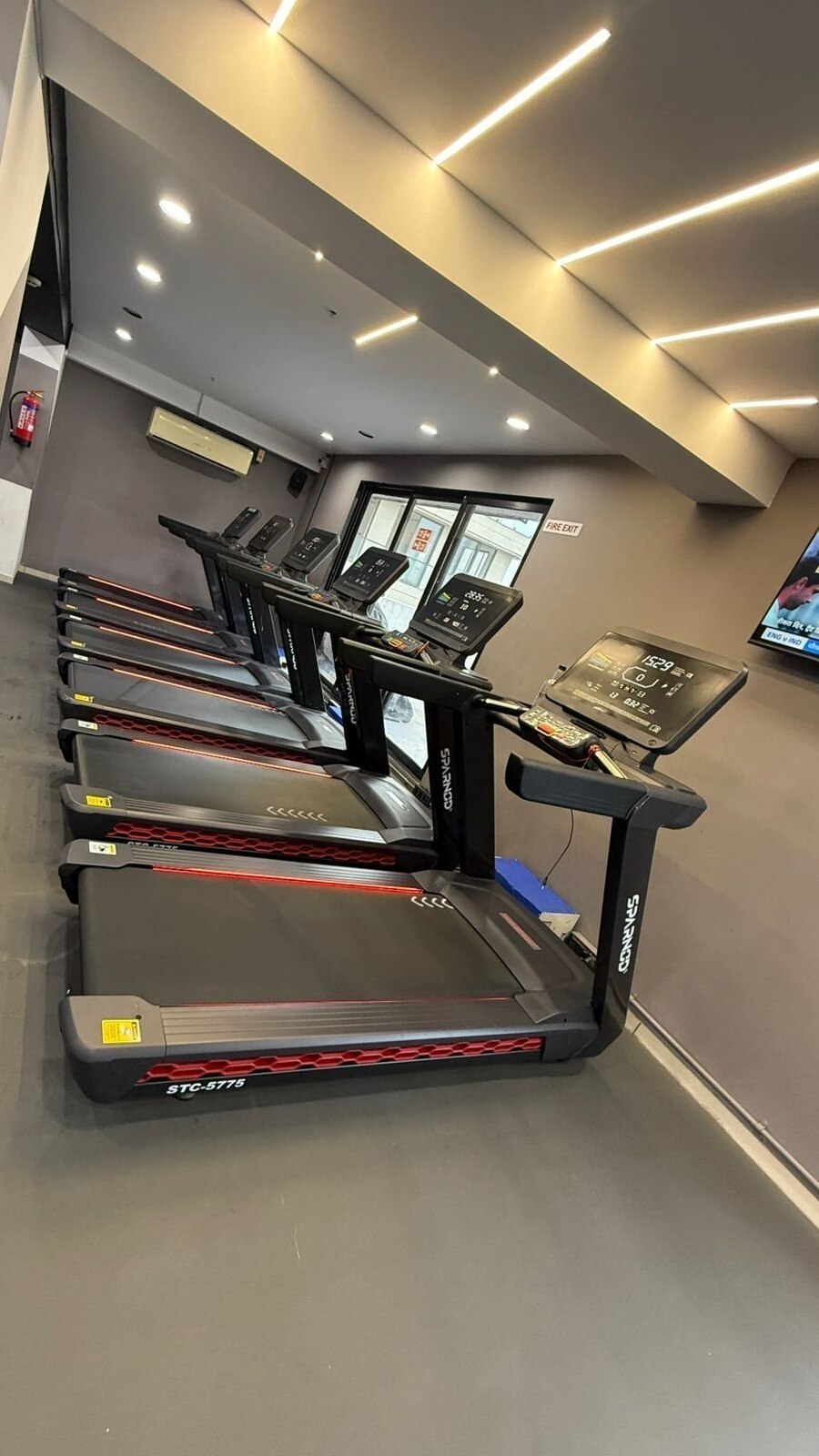
 | Gym Equipment's Treadmills- STC-5765 (5.5 HP AC MOTOR) COMMERCIAL USE TREADMILL Elevate your fitness journey with our high-performance treadmill featuring a 5.5hp continuous motor and 180KG user weight capacity. View product → |
Frequently asked questions
Should a commercial gym choose a stair climber or treadmill?
Choose a treadmill when members need broad access and adjustable intensity. Choose a stair climber when they need demanding vertical conditioning.
What should you compare besides motor horsepower?
Compare movement type, user capacity, deck or step dimensions, duty rating, controls, safety features, service access and warranty terms.
How do you calculate the ownership cost of cardio equipment?
Include purchase cost, electricity, preventive maintenance, replacement wear parts, labour, expected downtime and the revenue lost when a machine is unavailable.
What should you check in the room before ordering?
Measure delivery access, machine footprint, operating clearances, ceiling height, floor loading, ventilation, flooring and the available electrical supply.
How can you verify a commercial gym equipment quotation?
Ask the supplier to state the exact model, specifications, included installation, warranty coverage, service response terms, spare parts support, taxes, delivery charges and commissioning documents.
Related products
 | Gym Equipment's Treadmills-STC-4350 COMMERCIAL TREADMILL Experience peak performance with our 3hp continuous and 6hp peak motor treadmill, designed for users up to 140kgs. View product → |
 | Gym Equipment's TREADMILL- STC-4850 (4 HP AC MOTOR) SOLID BUILD COMMERCIAL HOME USE TREADMILL The STC-4850 is a top of the line commercial home treadmill that is perfect for use in homes or Fitness centers. View product → |
 | Gym Equipment's STC-4850 (4 HP AC MOTOR) SOLID BUILD COMMERCIAL HOME USE TREADMILL The STC-4850 is a top of the line commercial home treadmill that is perfect for use in homes or Fitness centers. View product → |